

Dissecting 'The Devil Wears Prada 2'
Plus a review of Anne Hathaway’s other new movie, 'Mother Mary.'
Happy Met Gala Monday to those who celebrate! As a little gift to my beloved readers, you get a bonus newsletter today. If you enjoy it, consider upgrading to a paid subscription. You’ll get twice the content for the low, low price of one fancy latte a month.
I’m not a scientist, but I’m pretty sure that if you sliced me open and chiffonaded my DNA, you would find strands of The Devil Wears Prada woven into the mix. It came out in 2006, when I was a fashion-crazed high school freshman, and although I was probably heading for a career in journalism one way or another, the film all but guaranteed that outcome. Sure, Meryl Streep’s now-iconic performance as Miranda Priestly — a fictionalized version of Vogue’s Anna Wintour — made the world of magazines seem stressful and unforgiving. But it also made working in media look thrilling. Like the only place worth being.
On Thursday, I went to see The Devil Wears Prada 2 with friend of The Scumbler Lily Meyer, who last appeared in its pages to tell us how to write a great sex scene. I was nervous, because DWP2 seemed like precisely the kind of sequel that could buckle under the weight of fan service and too many celebrity cameos. I’m pleased to report that it’s quite good! It’s also a mostly-frank look at the state of publishing in 2026. As you know — as I’ve written before in this newsletter, and as veteran journalist Sally Quinn noted just last week — media is a disaster zone right now. Somehow, the movie manages to contend with this reality without being a total bummer.
I dropped by Lily’s backyard on Saturday to talk through our feelings about the movie and its portrayal of the industry that (mostly) employs us both. (Lily is a staff writer at The Atlantic, as well as a translator and novelist.) After our conversation, which I’ve faithfully transcribed for your reading pleasure, I’ve got a capsule review of Anne Hathaway’s other fashion-related film, Mother Mary. My most generous take: It’s not for me! (Alex liked it, though.)
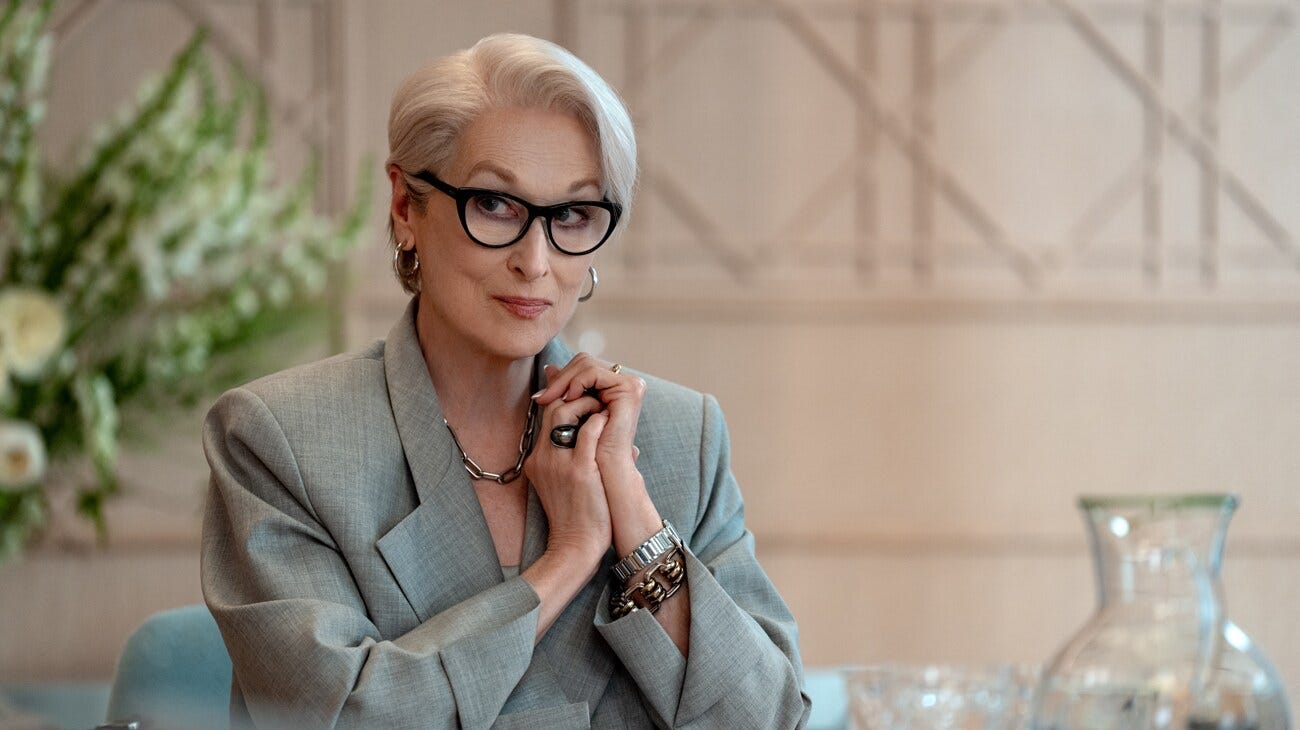
The following conversation includes spoilers for The Devil Wears Prada 2. As always, it’s been condensed and edited for clarity.
Eliza Brooke: We saw The Devil Wears Prada 2 on Thursday. What thoughts have bubbled up for you in the past couple days?
Lily Meyer: I’ve been thinking about the fact that I don’t like to be pandered to in books, but I actually love movies that pander to me.
Eliza: Explain.
Lily: When a book is catering to a female writer, probably white, living in an East Coast city, very likely a mom, it’s an overwhelming amount of pandering. But a broad strokes Hollywood pander to every girl, gay, and they between 15 and 60 — that’s my junk food. Oceans 8 is the movie that made me realize this about myself. Does that resonate for you?
Eliza: I hadn’t thought about it before, but I agree that it’s nice to feel like the target audience for a movie, especially when you’re seeing it in a theater. It’s a sweet communal experience. So many movies, famously, cater to straight men’s interests, that it’s gratifying to feel like someone’s making a product just for you. But it actually has to be good, otherwise it quickly feels like an insult to your intelligence. See Emerald Fennell’s Wuthering Heights.
DWP2 definitely speaks to both of us, too, because we’re writers and it’s about the collapse of the media business. In the 20 years since the original came out, Condé Nast — the parent company of Vogue — has become a hollowed-out shell of its former self. That’s the state of affairs when we return to Miranda Priestly’s Runway magazine, which is a lot less glamorous and influential than it used to be. There are some aspects of the script that feel a little inaccurate, but for the most part, I think Aline Brosh McKenna, the writer of both DWP movies, nailed the feeling of working in media in 2026, which is that it’s all about finding a toehold for right now.
Lily: If you think about it, the first movie was about the media, too. It seemed like it was about fashion, but, in fact, it was about the power of a fashion magazine. So it’s completely coherent that this one would be about how the media has been disempowered.
Eliza: And how did that make you feel?
Lily: Grateful for my job at The Atlantic, as if I were not conscious, every day, of the rarity of it. Grateful to have a toehold for right now. I’m also hoping that non-media people who watch the movie will be a little bit awakened or alerted by it.
Eliza: I want to talk about the crescendo of the movie, which is all about who gets to decide whether a publication lives or dies. Runway and its team are on the chopping block, and in an effort to save the magazine, Anne Hathaway’s Andy teams up with her former colleague, Emily (Emily Blunt), to convince Emily’s billionaire boyfriend — a Jeff Bezos type played by Justin Theroux, who is very funny in the role — to buy Elias-Clark, the owner of Runway. This itself feels a little unbelievable, because there’s no way a reporter like Andy would trust a tech billionaire, but I guess she’s a bit of a pollyanna. Then the scheme goes awry when Emily makes a power grab to take over the magazine, and Sasha Barnes, a MacKenzie Scott figure played by Lucy Liu, swoops in to save the day.
This chain of events gives you what you want from a movie like this, which is wish fulfillment. At a time when billionaires keep buying media companies and then gutting them — as Bezos did to the Washington Post — it would be so nice to have your employment guaranteed by a “good billionaire,” a.k.a. Bezos’s philanthropist ex-wife. But even that is a precarious kind of patronage. At the end of the movie, Miranda’s response to the sale is, essentially, that she and her staff are safe for right now. Sasha will stay out of her way for at least a little while, and Runway will live to fight another day.
To me, that’s a satisfying but sober ending. It didn’t feel delusional. That said, the part about Miranda being forced to fly coach due to budget cuts is wildly inaccurate.
Lily: Sometimes I see a shot or a gag in a movie and think, “They put that in for the preview.”
Eliza: Yeah! That felt disingenuous. Miranda will always fly first class.
Lily: Especially when you see her then staying in the most luxurious hotel suite in Milan. And you know what her house looks like.
Eliza: Absolutely. One of my other “media feelings” while watching this movie was that Emily, who is the funniest character in the first movie, was smart to get out of magazines and land a corporate job at Dior. I have a lot of colleagues who have gone to work at brands, and I’m always like, Maybe that’s a better path.
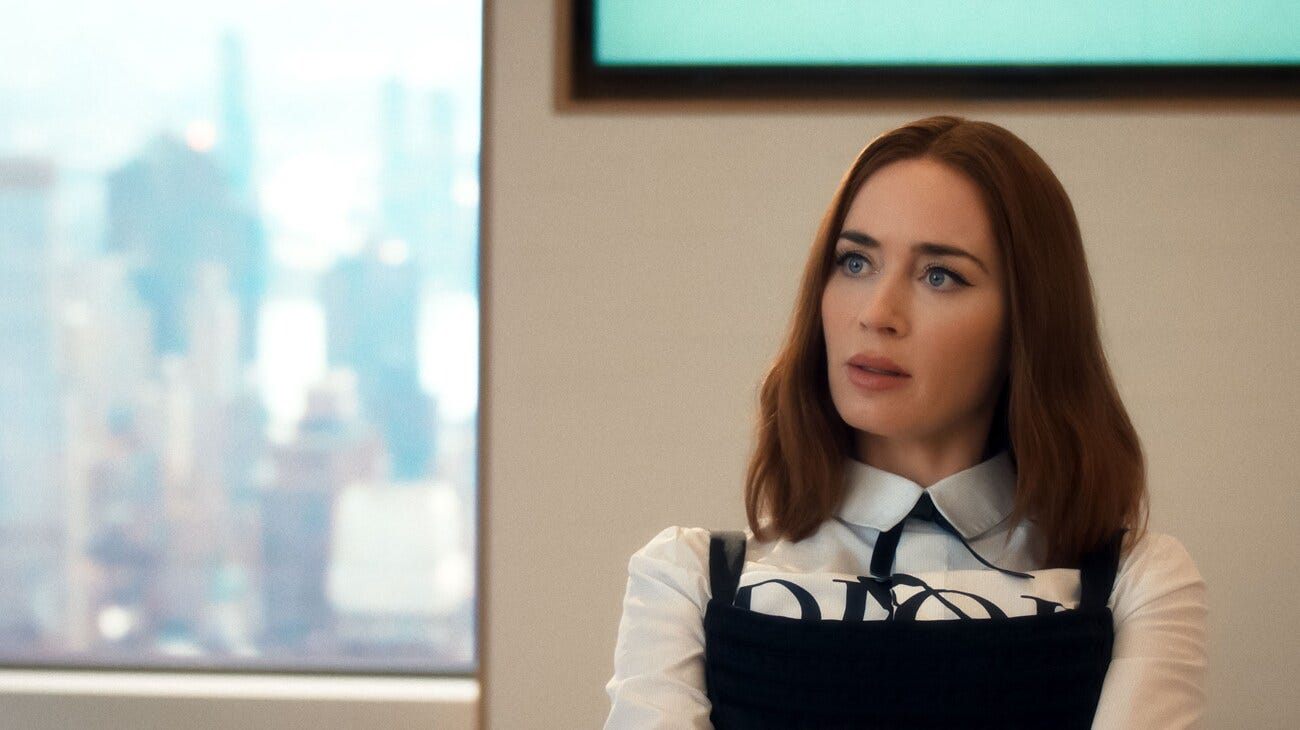
Lily: My particular media experience is not having colleagues who go work for brands.
Eliza: Yeah, what’s the sell-out move in the literary world?
Lily: There almost isn’t one. For people in creative writing, you teach, and teaching is not selling out. It’s the opposite. I guess there’s writing a sell-out novel —
Eliza: Right, you can sell out artistically.
Lily: Yeah, but you can’t sell out artistically knowing you’ll succeed at doing so. There’s no Dior for novelists. I guess, to go full circle, it’s to have a career as a novelist and then begin to write books that are pandering.
Eliza: That makes sense. Going back to the bedraggled state of Runway, I thought one of the other nice surprises of the movie was how subdued Miranda was. Defeated isn’t exactly the right word, but she’s muddling along.
Lily: She’s aware of her vulnerability, I think.
Eliza: Given how much support Vogue has given to this movie — and considering that its May cover featured Meryl and Anna together — my assumption was that Anna would have had a lot of say over how Miranda is portrayed. I was pleased by how much the character deviated from Anna’s public persona, which continues to be impenetrable and formidable. Did you watch that video she did with Chloe Malle, her Vogue successor, for the New York Times?
Lily: I did not. Do you know this about me? I don’t watch videos.
Eliza: That is so weird.
Lily: I know, it’s really out of step with the age. But I do not like shortform video content.
Eliza: I mean, I’d get a lot of time back if I didn’t spend my life on YouTube. What’s your threshold for video length? Is it a television show?
Lily: Yes. However long Seinfeld is.
Eliza: Understood. Okay, so the Times did this sit-down with Anna and Chloe, who is the new editor of Vogue, to talk about the next phase of the magazine. There’s this bit where the reporter asks Chloe what she would do with the kind of budget that Vogue had in the 1990s. She has an immediate laundry list, including paying everyone 30 percent more. And Anna is like, “But to be clear, Jessica, we have a very healthy budget at Vogue.” It read as an inability to admit that things aren’t what they were.
In general, DWP2 has more storytelling integrity than I thought it would. That also applies to its callbacks to the first movie, which aren’t as heavy-handed as I’d feared. They’re little Easter eggs: the opening with Andy brushing her teeth, a street vendor holding up two turquoise belts, a quick shot of Miranda’s twins, who are now grown up. They pop up, and then the action moves along. Aline Brosh McKenna is a really smart writer — I’m just surprised Disney executives didn’t dumb down her script more.
Lily: It’s interesting that neither of us felt depressed about the reality of our industry after watching this movie. I think that means the movie succeeded, tonally.
Eliza: That’s exactly right. Weirdly, it made me feel comforted? If Miranda can be like, “You know what? We’re good for the next three years. Let’s carry on because I love this work,” then maybe that’s good enough for me.
Lily: I did look yesterday to see if someone had made a gif of Miranda saying “I love working” at the end of the movie. The things that Meryl Streep does with her face in that moment…
Eliza: She gives Andy a little conspiratorial smile, right?
Lily: First she makes her eyes red, which is a very powerful thing. And then I think they get rounder and light up, and then she does the little smile. It’s like she’s about to drool, thinking about working. It’s so beautiful. I also love working.
Eliza: That’s the thing! As Emily says in the first movie, “I love my job, I love my job, I love my job.” But I genuinely do love my job. I don’t want to give it up, despite the fact that the business is falling apart.
After we saw the movie, you had some feedback about the plot point in which Andy’s friend who works in book publishing — played by Rachel Bloom, noted Aline Brosh McKenna collaborator — suggests that she write a tell-all about Miranda. Can you explain why that was so unrealistic?
Lily: It occurs to me now that Miranda would potentially want Andy to ghostwrite her memoir and would have had her sign 18 contracts to do so. But setting that aside, first of all, Andy would not be negotiating this potential book deal with her friend. She would 100% have an agent. At some point in the past, she would have written a story that got optioned, and even if she didn’t already have an agent, she would not be dumb enough to be engaging in those conversations without one.
Also, the $50,000 advance that she’s first offered is comically low for a tell-all about Miranda Priestly. Ridiculous!
Eliza: By the end she gets up to $350,000.
Lily: That seems more right to me.
Eliza: We also have to discuss the clothes in the movie. What were your favorite looks?
Lily: I have to say, the outfits did not compel me in the way that I would have liked them to. I did love the dress that Andy wore to the Hamptons.
Eliza: The Gabriela Hearst patchwork dress. It’s very you.
Lily: I liked her belt in the last scene, too. I want a belt like that.

Eliza: Wait, what was the belt? That’s so specific.
Lily: It’s just because I’m in the market for a new belt. I want one with a little bit of hardware, for when I want to wear something really casual to work.
Eliza: You know, the way you’re describing that belt is how I felt about Andy’s brown leather jacket at the end of the first movie. Like, that’s a cool journalist lady who’s casual but also totally put-together. That’s who I wanted to be.
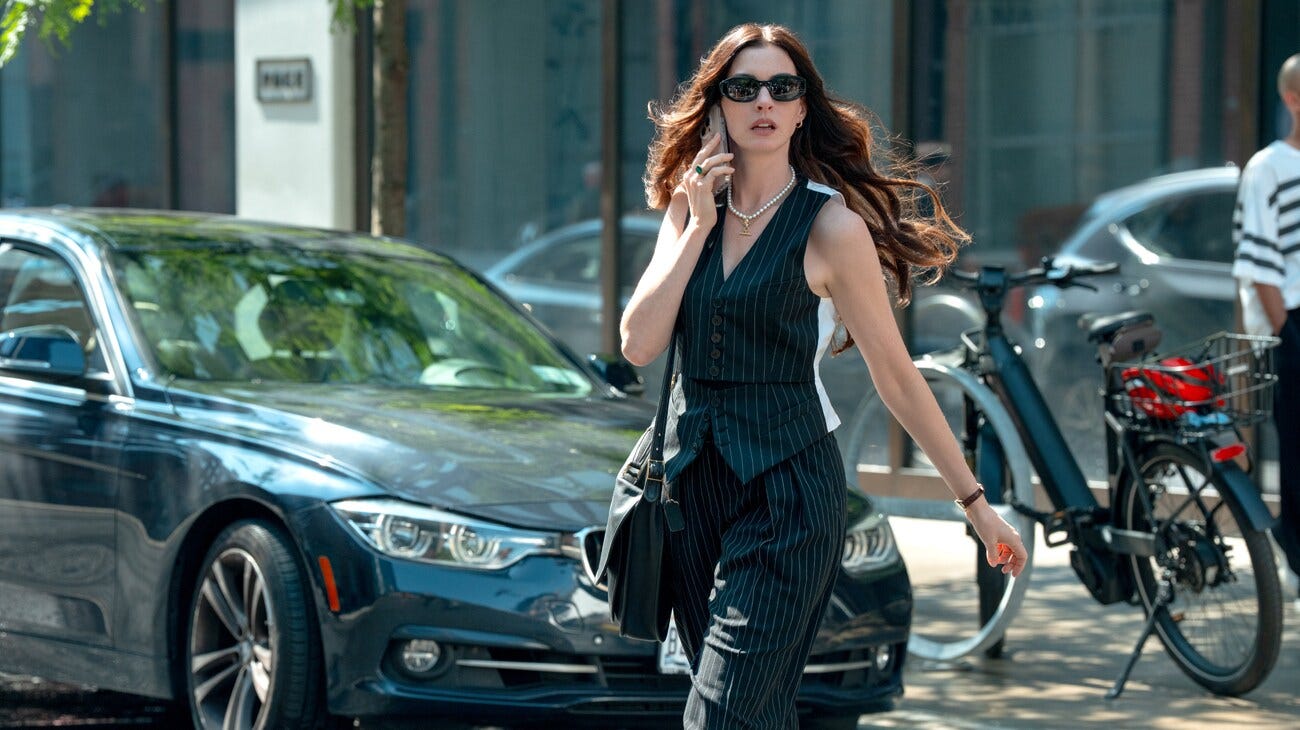
Lily: What were your favorites?
Eliza: I liked Andy’s various suits, and I was partial to the plaid mesh shirt she wore with that black pleated skirt. And I also loved the sparkly Armani overcoat that Miranda wore to Runway’s Milan gala, with the black sequins and multicolored gems. The child in me was like, I need to touch that.
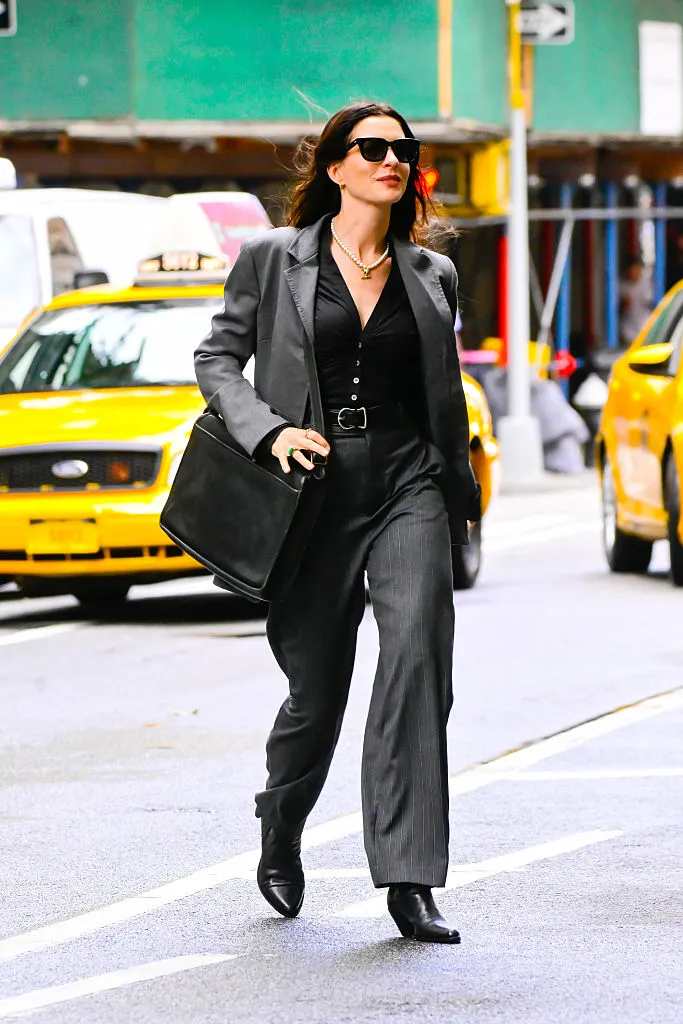
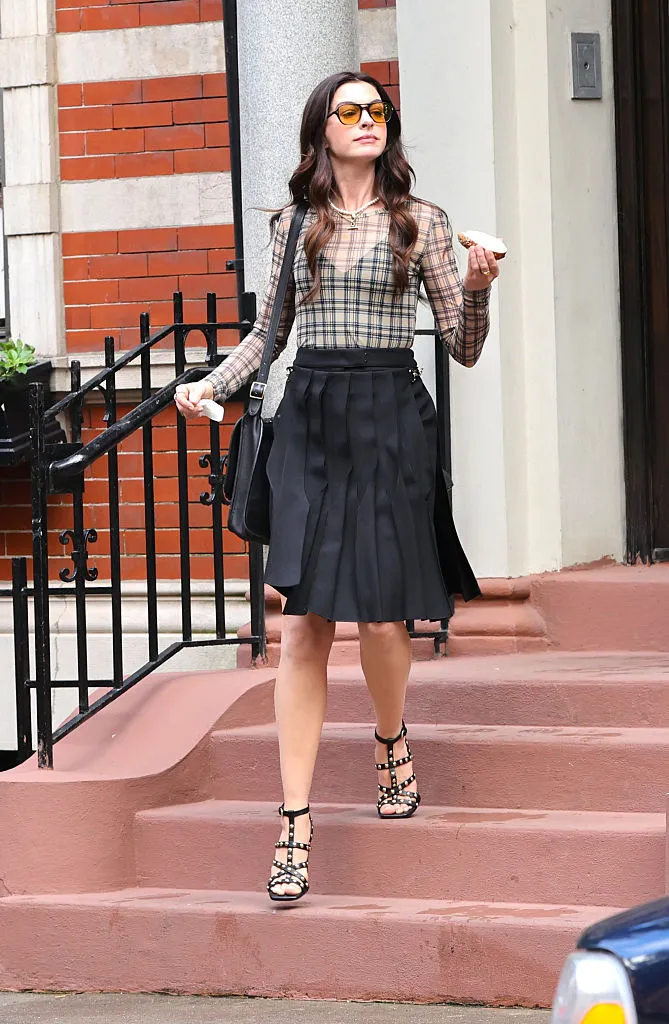
I know you also clocked a bunch of home goods that I personally could not identify.
Lily: Yes. Andy’s friend Lily (played by Tracie Thoms), who now works at an art gallery, has the same plate that I have from East Fork. I believe she also has the salad bowl from East Fork. Classic millennial wedding registry items — unbeatable. There were big Block Shop prints in the model apartment unit that Andy and Lily visit together after Andy has gotten hired at Runway. And there was the Beata Heuman “Monster” salt pig that Andy has when she moves into the apartment.
Eliza: Do you think Lily gave that to her?
Lily: Yes, definitely, as a housewarming present. Readers of The Scumbler, if anyone is compelled to buy me one…
Eliza: …we will share Lily’s home address with you.
Lily: We will not. I really wanted more of Lily’s home. I would have been happy with a movie that was a tour of that apartment.
Eliza: Someone who works in the art world should fact-check her financial success, but it seems like she’s doing great, and I was happy for her.
The last thing I need to say is that at the beginning of the movie, when Andy has gotten laid off from her reporting job, Lily says to her, “Why don’t you come work for me at the art gallery? I need someone who can write good copy!” The way that I was ready to write an email to a fictional character asking for work — it was instinctive. Like, it crossed the threshold into my reality.
Lily: Yes, that was how the movie broke the fourth wall, with the gallery copy job that everybody dreams of.
Eliza: Andy was so stupid not to take that job.
Lily: Bad move, Andy!
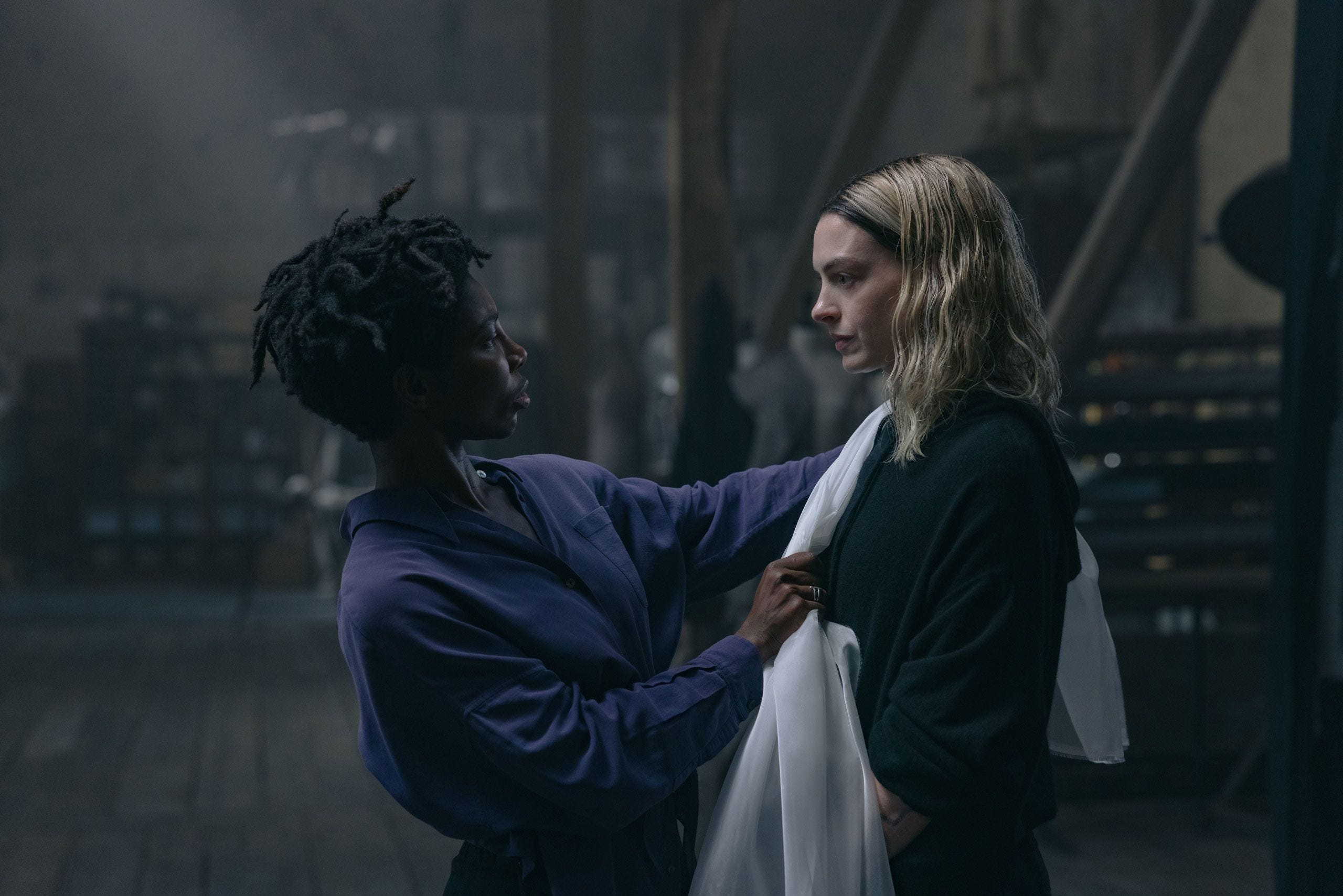
But wait: there’s more! Anne Hathaway has another movie out — Mother Mary, from director David Lowery, which expanded to wide release last week. Unfortunately, that one didn’t speak to me. You win some, you lose some.
It should have been entirely my shit. A pop star known as Mother Mary (Anne Hathaway) and a fashion designer, Sam Anselm (Michaela Coel), reunite after a falling-out to craft a dress for a comeback performance. The star is desperate; the designer, who is the original author of Mary’s image, is the only one up to the job. There is glittering concert footage, an atelier in the English countryside, original music by Charli XCX and Jack Antonoff, and a spooky, supernatural bond between the two women. Eliza bait, right?
I found it almost unbearably tedious. Not a whole lot happens in Mother Mary: It’s a one-idea story, the idea being that sometimes friends hurt each other. For nearly two hours, the audience is forced to marinate in Mary and Sam’s wretched feelings, which are so entrenched by this point as to give the film a feeling of awful, overpowering stagnation. This has nothing to do with the talents of Hathaway and Coel, who are great performers and perform greatly. But Hathaway spends most of the movie quivering with haunted despondency — a note that gets old after a while — and Coel delivers several long, opaque monologues that burn with emotion but left me thinking: Huh? There are some arresting visuals, but even those weren’t enough to keep me engaged.
I’ve softened on Mother Mary since seeing it, simply because I appreciate what Lowery is about as a director. I like, for instance, that he’s balanced pragmatism and artistry in his career, alternating between making family-friendly Disney movies (Pete’s Dragon, Peter Pan & Wendy) and weird indie pictures (A Ghost Story, The Green Knight). I love that Mother Mary has zero speaking roles for men. I deeply dig that, in its first appearance, the ghostly apparition tormenting Mary and Sam is a puppet! I wish nothing but fortunate parking spots, flawless avocados, and uninterrupted sleep to anyone who puts puppeteers to work.
All this to say, I’m not mad that I saw Mother Mary. I’m happy it got made! But I don’t see myself revisiting it.
That’s all…
Eliza
A former longtime journo here and I also felt the pain of that industry. I went with my daughters aged 12&15 and we all really enjoyed it. Stanley Tucci is forever a mensch
Soooo interesting and a really good take as this film has been panned by viewers in the UK.....but i guess the average viewer doesnt get what's going on in media (and definitely print) right now?
Your piece made me want to watch this film.