

The games that a board game designer actually plays
Welcome to the fun zone.
My older brother has the coolest job in the world. I know this because every time I tell someone that Max is a board game designer, they respond: “That’s so cool.” And it is. I love bragging about him, partly because he’s an extremely modest and even-tempered person who won’t brag about himself.
The Scumbler doesn’t usually cover games, but here’s what I do write about: fun things to do in your leisure time. People with unusual creative jobs. The eternal human urge to craft something novel for others to enjoy. So I invited Max to share some game recommendations with us today, in response to seven prompts provided by moi. This includes:
A game guaranteed to add some drama to your next party
A gentle game for your friends who can’t deal with conflict
A game for your friend who cannot absorb or retain rules to save their life
A game that will melt your mind (in a fun way)
We’ll get into his recs in a minute — you’ll find them below the paywall — but first, I asked Max to tell us a bit about how he became a board game designer. (If you want to dig deeper into how a game actually gets made, check out his design blog.) Here’s our chat, condensed and edited for clarity. Also, I recommend everyone interview their sibling(s) at some point. You’ll probably learn something about their life that you didn’t know before. I certainly did!
I very distinctly remember lurking in the background of your high school game sessions, which usually took place in the living room. But when did your love of games begin?
In elementary school, I got really into the Pokémon card game. From there, I got into Magic: The Gathering and then Warhammer. In college, I finally got a chance to play role-playing games, like Dungeons & Dragons and Warhammer 40,000: Dark Heresy, and I realized that was what I was looking for the whole time.
From there, how did you break into the industry?
During my junior year of college, I threw out my name for summer internships at game companies, which were pretty few and far between. But I actually found one, at University Games, which is a game and toy company in San Francisco. It was a useful experience because their business model is built around mass market games, which are a very different beast from the hobby games that I was into. In a hobby game, 20,000 units is a really good first print run. In the world of mass market games, 20,000 is the experimental print run that you do before you commit real money to your project.
During college, my total lack of progress on game internships outside of University Games led me to believe that it would be pretty hard to get a job in the board game industry. I set out to find a job after graduation doing something related, like video game marketing. By chance, I saw a job at Fantasy Flight Games as a role-playing game producer, and I applied because I had experience managing freelancers at a marketing agency. Apparently that’s what got me the job — not the board game connection, although that helped, but having managerial experience.
They told me the job was mine if I was willing to move to Minnesota, and I said, “Great!” I love our parents, but I was crawling up the wall and didn’t want to live with them anymore.
[Cackling unprofessionally]
It was a lucky time to be at Fantasy Flight. That was right around the time that they got the Star Wars game license. I was working as a producer — a role that combined design and project management — and then they offered me a position doing full-time design work on Star Wars X-Wing, which is a miniatures game. After that, I did some work on Star Wars: Armada, and got to help with testing Star Wars: Legion. Those were my years in the plastic spaceship mines.

After you left Fantasy Flight Games, you joined me in the freelance world. When was that?
I left Fantasy Flight in 2020 to go freelance as a game designer and consultant. In 2025, I realized there are some games that nobody’s going to hire me to make and that I need to make for myself. So I founded Wild Plum Games, which is my game studio.
What are those games that you feel like you need to — and can — make at Wild Plum?
There isn’t a specific type of game. We have two games in development right now. One isn’t my design — it’s actually my wife Debbie’s design. It’s called Tulip Traders, and it’s a bluffing card game about the Dutch tulip boom. The other, Precipice, is a giant robot war game. What unites these games is that I want to take those years of project management, designing, and consulting, and make games that deliver a lot of bang for their buck in all respects.
That means games that are designed and packaged efficiently, with minimized waste. That’s hard to explore when you’re just the designer and someone else is making the financial decisions. A lot of games out there, including some that I’ve made, are very high-end and high-cost products. It’s not bad that those exist, but I think that it’s good when there are accessible and affordable entry points for people, too. I want to try to deliver that premium value, as much as I can, at a lower price point.
That makes a ton of sense. Final and most important question: What are your favorite games to play right now?
It’s always tricky when you’re a game designer, because you have to make time to play games that aren’t the things you’re working on. Debbie and I have played Cascadia quite a bit, and I’ve been enjoying an interesting game called GHQ. It was designed by Kurt Vonnegut, of all people, and went unpublished during his lifetime. Before he became a famous novelist, he attempted to become a board game designer and failed.
What?!
Yeah. This is his take on a chess-like war game that was supposed to be an accurate view of how command functions in wartime. While writing Cat’s Cradle, he was looking at other opportunities and designed GHQ. He tried to shop it around, and it never went anywhere. Then, in 2024, Mars International updated the design and turned it into a whole game. It’s a really good tactical war game that’s pretty simple but strategically complicated. It’s an interesting historical object, as well!
Without further ado, it’s time for Max’s game recommendations, which may offer inspiration for your next game night. Whatever the vibe — whatever your friends’ appetite for conflict and betrayal — there’s something in here for everyone.
A game for when the party is a little too tame and you want to inject some drama into the evening
I would go with Welcome to the Dungeon. It’s a quick-playing game — each round takes 10 to 20 minutes — and it’s interesting because it plays very differently with two players than it does with three or more players. It’s sort of a game of chicken: You have an adventurer who’s going into the dungeon, and you have the dungeon that’s getting constructed. Every turn, you can choose to either put something in the dungeon, like a monster or a dragon, or take an item away from the adventurer. Eventually you’ll say “pass,” and once everyone has passed, the next person has to see if the adventurer can make it through the dungeon.
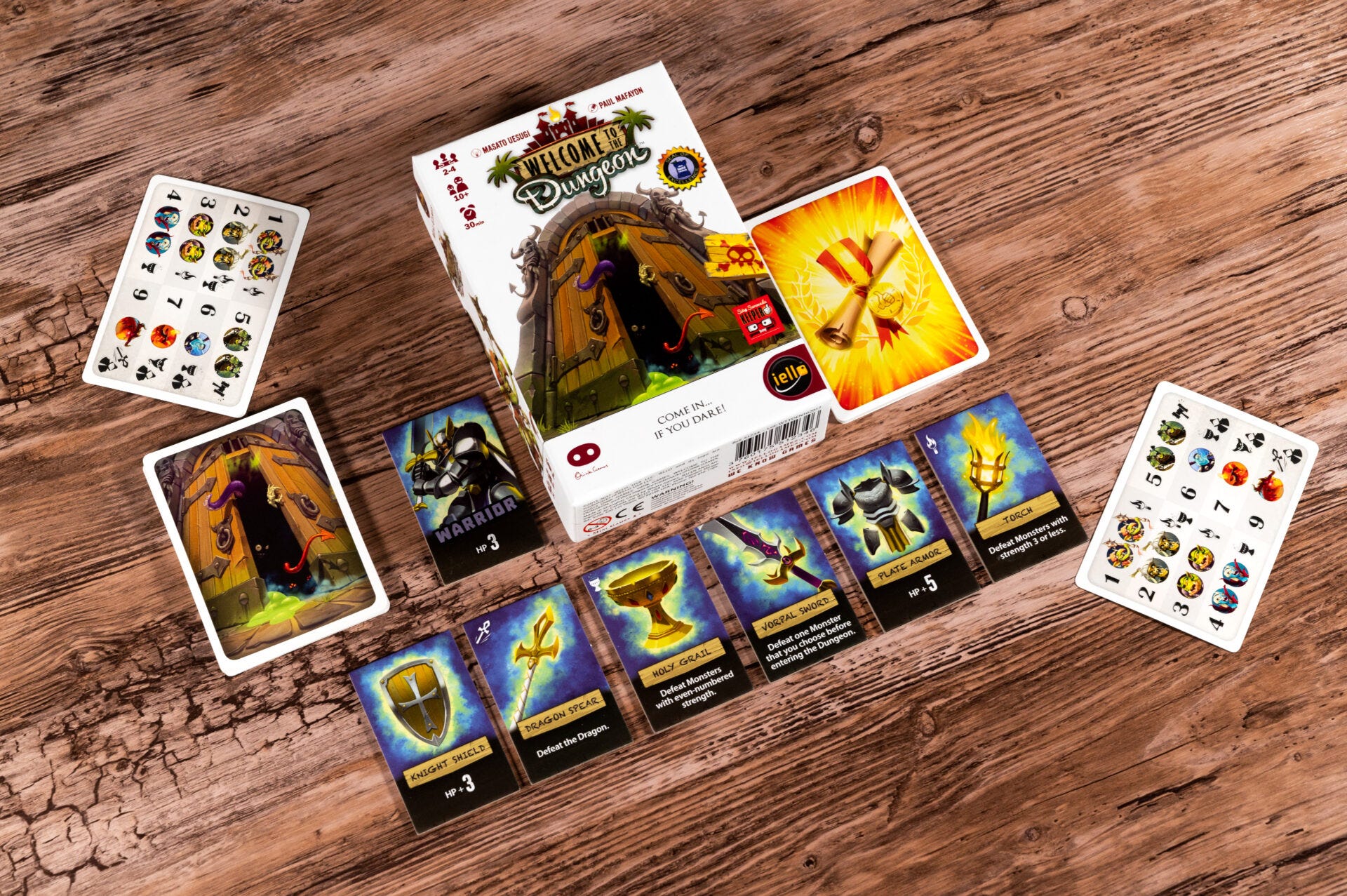
If you play with three or more people, you have very little information about the cards in the dungeon, and it gets extremely chaotic. Most of the time, when the adventurer goes into the dungeon, it’s this nail-biting moment, and everyone is really engaged as you’re flipping each card over. One thing I look for in a game’s design is how much it keeps everyone engaged — not every game needs to do that, but it’s something I like a lot.
When I was first introduced to Welcome to the Dungeon, my friends and I played a bunch of rounds back to back, and it got very tense. But one of the things I like about the game is that you can open it up in the middle of a party, play for a bit, and then move on to something else. You don’t want to break out a big board game halfway through a party, even if it would be great for creating drama. With this game, you’ll have time to do other stuff afterward.
A game for your conflict-avoidant friends who can’t handle the heat (and want to stay out of the kitchen)
Originally I considered a cooperative game for this prompt, but I actually decided that’s not the best answer. Cooperative games either require someone to be the quarterback, or they’re games where the players are hiding information from one another. If someone screws up, it can be worse than in a competitive game, because in the latter scenario, you’re just screwing yourself over. In a cooperative game, you’re letting the team down.
Keep reading with a 7-day free trial
Subscribe to The Scumbler to keep reading this post and get 7 days of free access to the full post archives.